
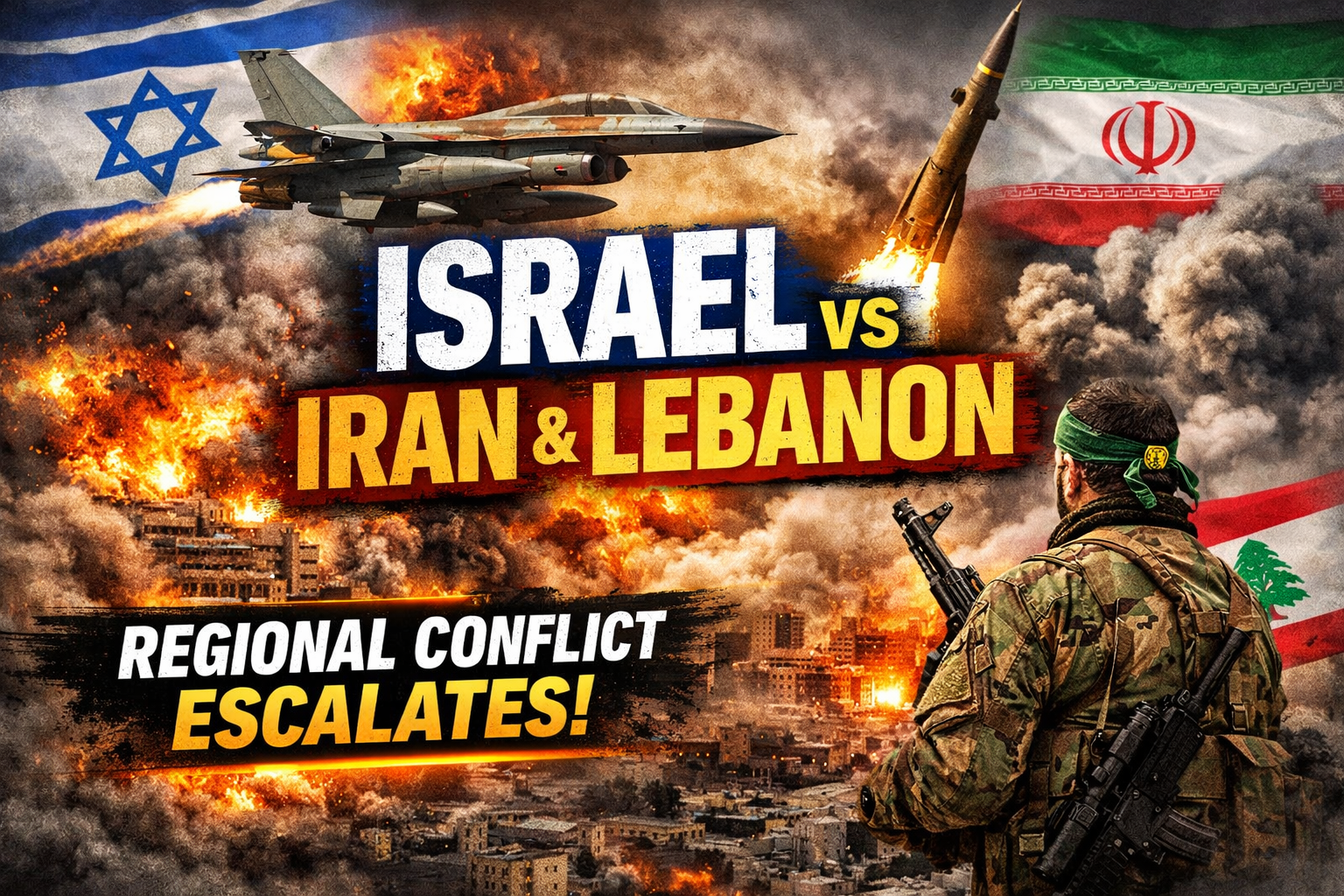
The Middle East is once again at the center of global attention as Israel intensifies its military campaign across multiple fronts, directly targeting Iran while simultaneously expanding operations in Lebanon. What began as a series of strategic strikes has rapidly evolved into a broader regional conflict, raising fears of a prolonged war with global consequences. The escalation reflects years of geopolitical tension, proxy warfare, and unresolved disputes over security, nuclear capabilities, and regional influence.
Background of the Conflict
The roots of the current escalation lie in longstanding hostilities between Israel and Iran. Israel has consistently viewed Iran’s nuclear ambitions and missile development as existential threats. Meanwhile, Iran has supported regional proxy groups—most notably Hezbollah in Lebanon—that oppose Israel’s presence and policies in the region.
In late February 2026, Israel launched a large-scale operation targeting Iranian military infrastructure, marking a turning point in the conflict. This campaign, supported in part by the United States, aimed to weaken Iran’s military capabilities and disrupt its regional network of influence.
Expansion Into Lebanon
As tensions with Iran escalated, Lebanon became a critical secondary front. Hezbollah, an Iran-backed militant group, entered the conflict by launching attacks into Israeli territory. In response, Israel significantly increased its airstrikes across Lebanon, particularly in Beirut and the southern regions.
These strikes have targeted what Israel describes as Hezbollah command centers, weapons storage facilities, and logistical infrastructure. However, the consequences for civilians have been severe. According to recent reports, over 1,000 people have been killed in Lebanon, and approximately one million have been displaced amid the ongoing bombardment.
Israeli operations have also expanded to include key infrastructure such as bridges and transport routes, aiming to limit Hezbollah’s mobility and supply chains. This strategy, while militarily significant, has further strained Lebanon’s already fragile economy and humanitarian situation.
Direct Strikes on Iran
Simultaneously, Israel has intensified its direct attacks on Iranian territory. These operations have included strikes on military installations, intelligence centers, and energy infrastructure. One of the most significant developments was the attack on the South Pars gas field—one of the largest in the world—which disrupted a notable portion of Iran’s gas production and triggered spikes in global energy prices.
Israeli forces have reportedly conducted thousands of strikes, targeting missile launchers, air defense systems, and paramilitary organizations such as the Basij. Despite these efforts, Iranian military structures remain resilient, continuing to operate and respond.
Iranian Retaliation
Iran has responded with a series of missile and drone attacks targeting Israeli territory and U.S. military bases across the region. In addition, Iranian strikes have extended to energy infrastructure in Gulf countries, including facilities in Qatar and other neighboring states.
These retaliatory actions demonstrate Iran’s capacity to project power beyond its borders and highlight the risk of the conflict spreading further across the Middle East. The use of advanced missile systems also signals a dangerous escalation in both scale and sophistication.
Humanitarian Impact
The humanitarian consequences of the conflict are profound. In Lebanon, widespread displacement, destruction of infrastructure, and mounting civilian casualties have created a crisis of significant proportions. Hospitals are overwhelmed, and essential services are struggling to cope with the scale of the emergency.
Within Iran, the population faces increasing restrictions, security crackdowns, and disruptions to daily life, exacerbated by damage to infrastructure and ongoing military operations. Meanwhile, civilians in Israel continue to face the threat of missile attacks, leading to heightened security measures and societal तनाव.
Global Implications
The conflict’s impact extends far beyond the Middle East. Energy markets have been severely disrupted, with oil prices surpassing $110 per barrel amid fears of supply shortages. The strategic importance of the Strait of Hormuz—a key global shipping route—adds another layer of risk, as any disruption could have far-reaching economic consequences.
International actors, including the European Union, France, and Japan, have called for de-escalation and diplomatic solutions. However, efforts to broker a ceasefire have so far been unsuccessful, with both sides showing little willingness to back down.
Conclusion
The escalation of Israel’s military offensive involving Iran and Lebanon marks one of the most dangerous phases in Middle Eastern geopolitics in recent years. With multiple fronts active, high civilian casualties, and global economic repercussions, the conflict has the potential to reshape the region’s political landscape.
Unless meaningful diplomatic efforts succeed, the situation risks spiraling into a broader war, drawing in additional countries and further destabilizing an already volatile region. The coming weeks will be critical in determining whether the conflict can be contained—or whether it will expand into a full-scale regional crisis.
Leave a Reply