
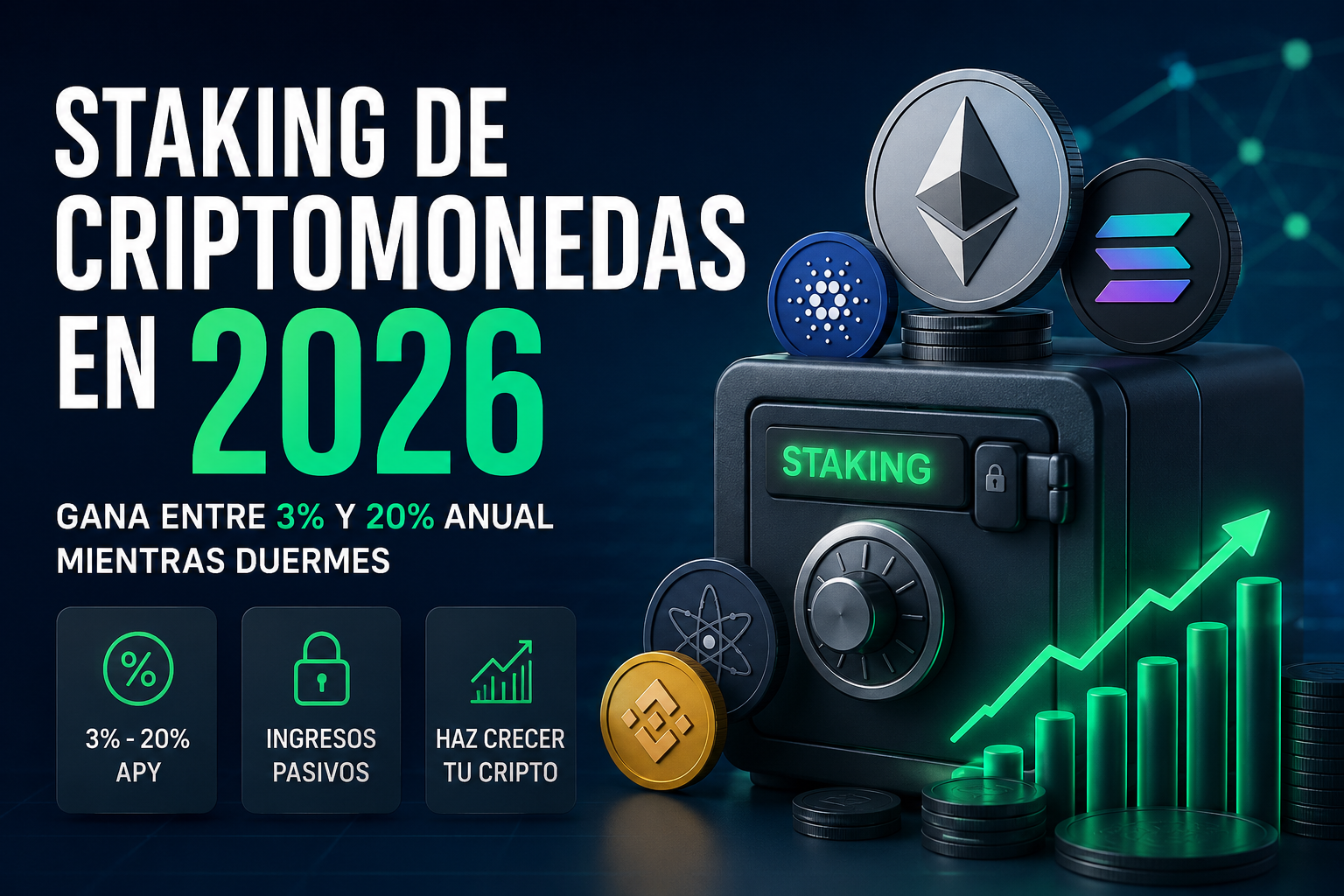
The most complete guide to earning between 3% and 20% annually simply by keeping your crypto in staking.
Imagine depositing money into a savings account that pays between 4% and 20% annually, instead of the 0.01% offered by many traditional banks. That is essentially what cryptocurrency staking allows you to do: lock your digital assets to help secure a blockchain network and receive periodic rewards in return.
In 2026, staking has become the preferred passive income strategy for more than 40% of long-term cryptocurrency holders. The numbers are massive: over $150 billion worth of value is currently staked on the Ethereum network alone, representing 29.6% of all ETH in circulation. On Solana, the staking ratio exceeds 66%.
4%
ETHEREUM STAKING APY
7.5%
SOLANA STAKING APY
~20%
COSMOS (ATOM) APY
How Does Staking Actually Work?
Networks that use Proof of Stake (PoS) require participants to “stake” tokens as collateral in order to validate transactions and maintain network security. In exchange for this service, participants receive newly issued coins as rewards. It is the digital equivalent of earning rent by putting your capital to work.
A concrete example: if you deposit $1,000 worth of ETH into a staking program offering 4% APY, after one year you will have earned approximately $40 in ETH rewards, paid directly in crypto. If you reinvest those rewards (compound effect), growth accelerates progressively over time.
The 4 Types of Staking You Need to Know
1. Direct Staking (Running Your Own Node)
You lock your coins directly on the network and operate your own validator. Maximum control and maximum rewards, but it requires technical knowledge and a minimum amount of capital (32 ETH on Ethereum, for example). Recommended for advanced users.
2. Delegated Staking
You delegate your tokens to an existing validator without operating your own infrastructure. Easier to manage, with slightly lower returns due to validator fees. Ideal for intermediate users with some technical understanding.
3. Liquid Staking (stETH, JitoSOL, etc.)
You stake your assets but receive a liquid token representing your position (for example, stETH on Lido). You can use that token in DeFi while continuing to earn staking rewards. The most flexible and powerful option in 2026.
4. Centralized Exchange (CEX) Staking
Binance Earn, Coinbase, Kraken, and similar platforms manage everything automatically. You simply deposit your crypto and start earning. The easiest option for beginners, although it involves custodial risk (you do not control your private keys).
Comparison of the Best Cryptocurrencies for Staking
| CRYPTOCURRENCY | APPROX. APY | DIFFICULTY | LIQUIDITY | RISK |
|---|---|---|---|---|
| Ethereum (ETH) | ~4% | LOW | High | LOW |
| Solana (SOL) | ~7.5% | LOW | High | MEDIUM |
| Polkadot (DOT) | ~14% | MEDIUM | Medium | MEDIUM |
| Cosmos (ATOM) | ~20% | MEDIUM | Medium | MEDIUM |
| BNB | ~5% | LOW | High | MEDIUM |
| Cardano (ADA) | ~4.5% | LOW | High | LOW |
💡 THE COMPOUND INTEREST STRATEGY
A small portfolio combining tokens such as ETH, SOL, ADA, DOT, and BNB, together with systematic reinvestment of rewards (restaking), can turn modest yields into substantial long-term income. The power of compounding is especially important in staking because rewards are paid in the same asset that may also appreciate in value over time.
Risks You Should Understand Before Starting
- Price risk: if the asset drops by 30%, your 7% rewards will not offset the capital loss. Staking does not eliminate volatility.
- Lock-up risk: some programs require lock-up periods of days or weeks before withdrawals are allowed. Liquid staking solves this issue.
- Slashing risk: in direct staking, malicious behavior or technical errors by the validator can result in penalties affecting your staked capital.
- Custody risk: on centralized exchanges, you do not control your private keys. The collapse of FTX was a major lesson about the risks of centralized custody.
Leave a Reply