
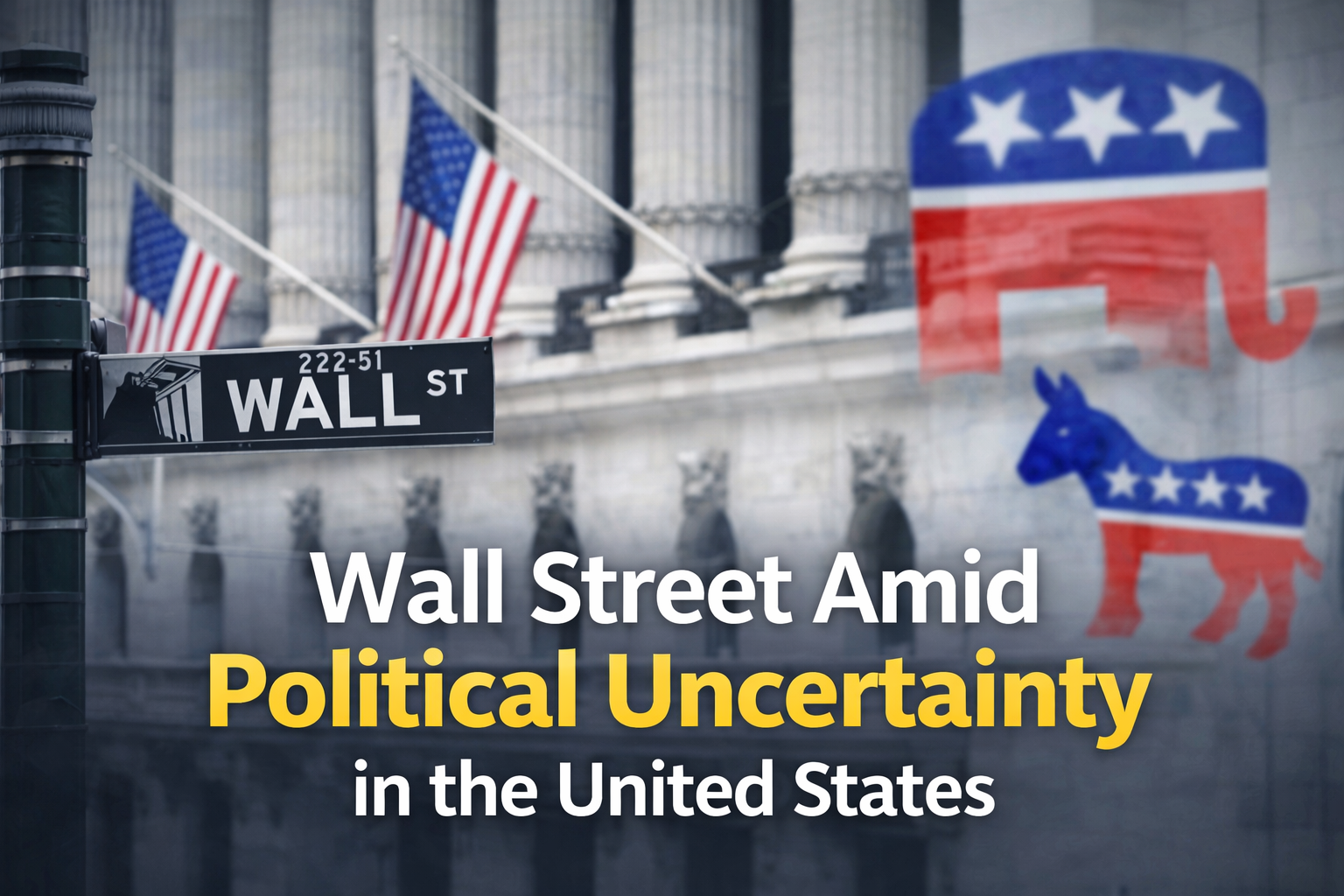
Financial markets thrive on predictability. Yet in recent years, Wall Street has increasingly had to navigate a political environment defined by polarization, shifting policy agendas, and electoral uncertainty. As the United States moves through another complex political cycle, investors are once again forced to assess how government decisions—and indecision—could shape the trajectory of the economy.
Politics as a Market Driver
Political uncertainty is not new to financial markets, but its intensity and frequency have grown. From debates over fiscal policy and government spending to regulatory changes and trade relations, political developments now play a more immediate role in market movements.
Key institutions such as the Federal Reserve operate independently, yet their decisions are often influenced by broader political and economic conditions. Interest rate policies, for instance, can become focal points in political discourse, especially during election cycles.
Similarly, legislative gridlock in Congress can delay critical decisions on budgets, debt ceilings, and economic stimulus—each with direct implications for investor confidence.
Market Volatility and Investor Behavior
Periods of political uncertainty tend to increase market volatility. Investors react not only to concrete policy changes but also to expectations and speculation. This can lead to short-term fluctuations in equities, bonds, and currency markets.
However, volatility does not always translate into long-term instability. Historically, markets have shown resilience, often rebounding once uncertainty is resolved or becomes more predictable. Institutional investors, in particular, tend to adopt a longer-term perspective, focusing on fundamentals rather than short-term political noise.
That said, sectors more exposed to regulation—such as healthcare, energy, and financial services—are especially sensitive to political developments.
The Role of Elections
Elections are among the most significant sources of uncertainty. The potential return or influence of figures like Donald Trump, for example, introduces questions about tax policy, deregulation, trade strategies, and international relations.
Markets typically begin pricing in possible election outcomes well in advance. While some investors attempt to position themselves based on expected policy shifts, others prefer diversification strategies to hedge against multiple scenarios.
Importantly, the relationship between election outcomes and market performance is not always straightforward. While certain sectors may benefit from specific policies, the broader market often depends more on macroeconomic conditions than on political leadership alone.
Global Implications
Political uncertainty in the United States does not remain confined within its borders. Given the central role of the U.S. economy, developments in Washington can influence global capital flows, exchange rates, and investor sentiment worldwide.
For example, debates over trade policies or sanctions can affect international supply chains, while fiscal decisions can influence global interest rates and liquidity conditions.
In this context, Wall Street serves not only as a domestic financial hub but also as a barometer for global economic expectations.
Structural Strengths and Long-Term Outlook
Despite recurring political turbulence, the United States retains strong structural advantages. Deep capital markets, robust legal frameworks, and a culture of innovation continue to attract global investment.
Moreover, the adaptability of financial institutions and market participants allows the system to absorb shocks and adjust to new realities. While political uncertainty may create short-term disruptions, it rarely undermines the fundamental strength of the U.S. financial system.
Conclusion
Political uncertainty is an enduring feature of democratic systems, and the United States is no exception. For Wall Street, the challenge lies not in avoiding uncertainty, but in managing it.
As investors navigate an environment shaped by elections, policy debates, and geopolitical tensions, the ability to distinguish between short-term noise and long-term trends becomes increasingly important. In this evolving landscape, resilience, diversification, and informed decision-making remain the key tools for success.
Leave a Reply